Works / 1974–1984

Early Works

Clay, pencil, laminated wood and the photocopier — the first works of a practice that keeps returning to repetition, the body, and how an image comes to be seen.

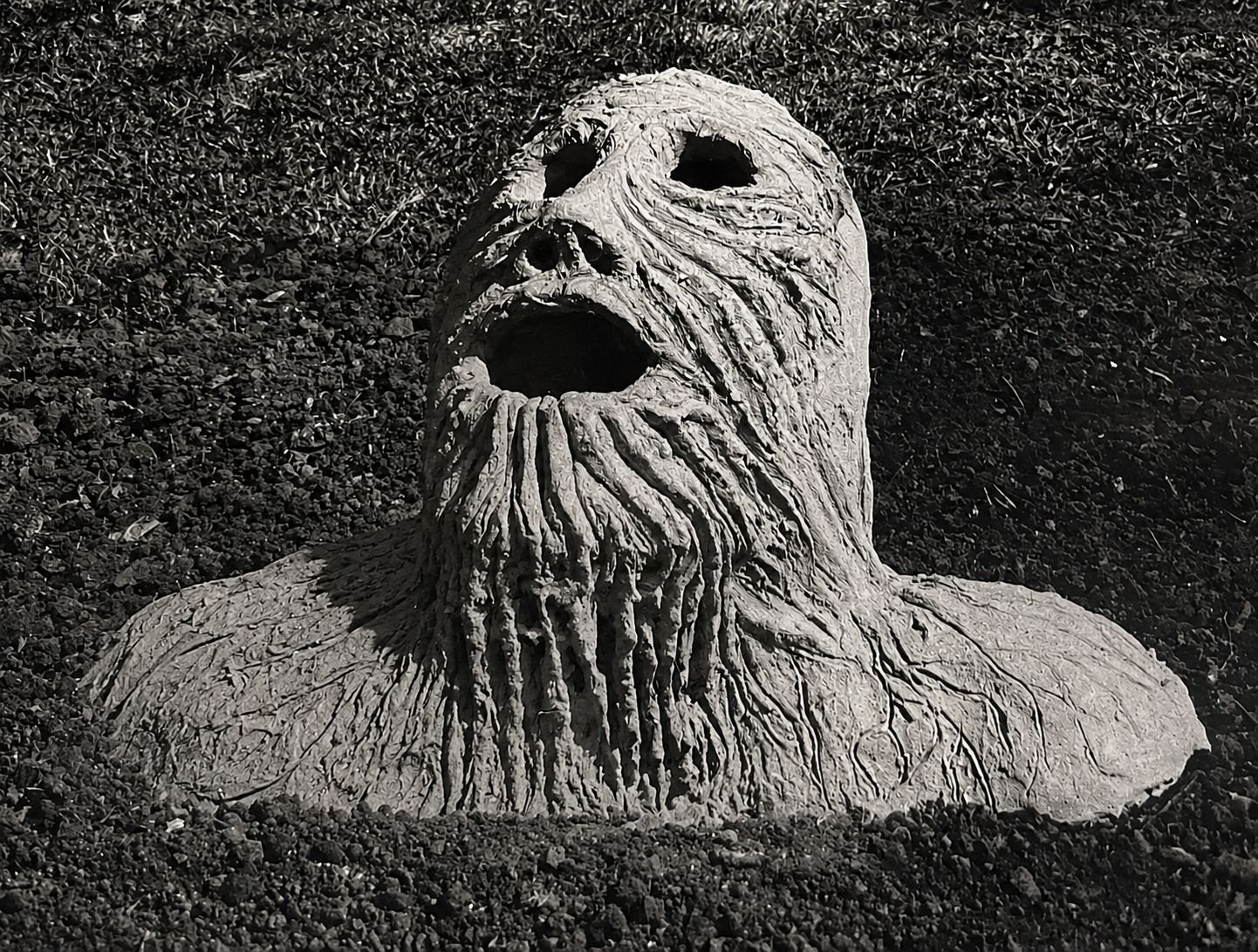
A roughly modelled clay bust with hollow eyes, an open mouth and an elongated neck.

01 — 1974–75

Spectator

Air-dried clay
Slightly larger than life

Spectator is a slightly larger-than-life bust made from air-dried clay before I entered art school. It was included among the works I submitted in support of my application.

The figure’s hollow eyes, open mouth and elongated neck create an expression that lies somewhere between astonishment, fear and an inarticulate cry. Its roughly modelled surface retains the direct physical action of the hands: the clay is stretched, scored and dragged into folds that resemble skin, sinew or weathered bark. This vigorous treatment gives the static bust an intense sense of psychological and bodily tension.

The title suggests someone who watches rather than acts, yet the spectator depicted here is not detached or passive. The experience of looking appears to have overwhelmed and transformed the figure. Its enlarged scale and frontal presence confront the viewer, reversing the usual relationship between observer and observed: we look at the spectator while it appears to look—or cry out—towards us.
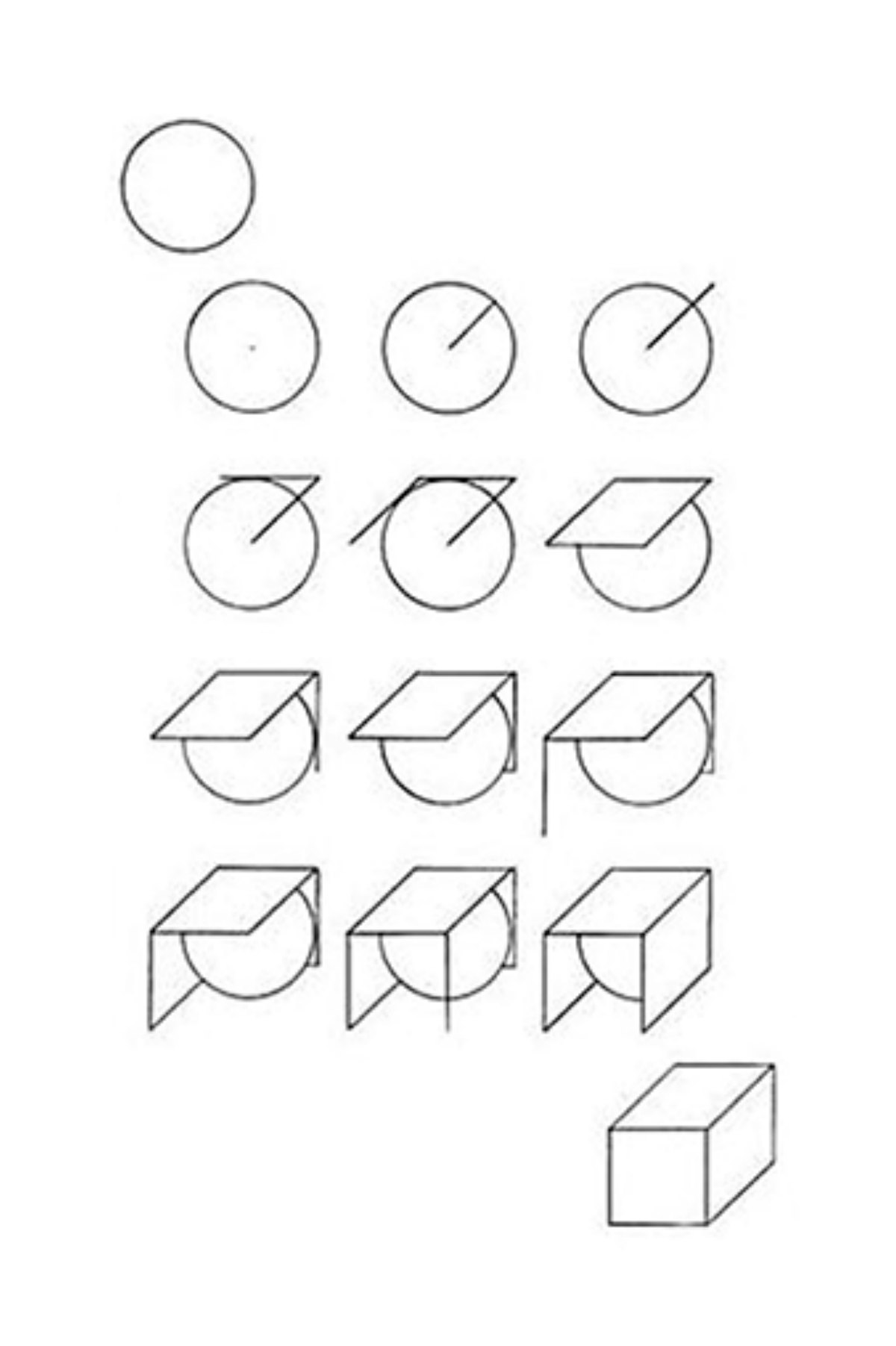
A pencil drawing of a sequence of figures in which a circle is gradually enclosed by lines until it becomes a cube.

02 — 1975

Circle to the Cube

Pencil on paper

Circle to the Cube is an early pencil-on-paper drawing in which a circle is progressively transformed into a cube. Arranged as a sequence of related figures, the work begins with an isolated circle. Diagonal, horizontal and vertical lines are then introduced around and across the curved form. With each repetition, these additions become more structurally assertive: a plane appears, then an edge, then a partial enclosure. The circle is gradually contained, divided and displaced until the sequence resolves into the unambiguous outline of a cube.

The drawing treats geometric transformation as a process rather than a single image. Its meaning lies in the intervals between one state and the next, where a minor alteration changes how the entire figure is perceived. Circle and cube operate as opposing but connected forms: one continuous and without corners, the other angular, bounded and spatially suggestive. The transition between them makes visible the act of constructing an image and the way perception completes forms that remain provisional.

Originally also described as an untitled drawing and as Circle to Cube, the work has existed in different states and sizes. It marks the beginning of my sustained investigation into structure, repetition and perception—concerns that continued through sculpture, photography, photocopy works, digital imagery and installation. Although modest in medium and execution, the drawing establishes a recurring method in my practice: beginning with an elementary form, subjecting it to a sequence of controlled variations, and using those changes to test how images generate movement, space and meaning.

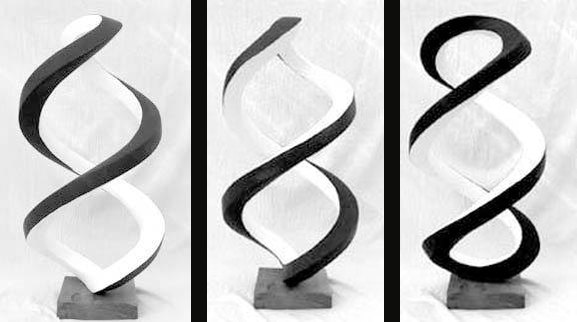
Three views of Wave, a tall twisting double-helix sculpture of laminated wood, one face painted black and the other white, on a small base.

03 — 1977

Wave

Painted laminated wood
1 m (h)

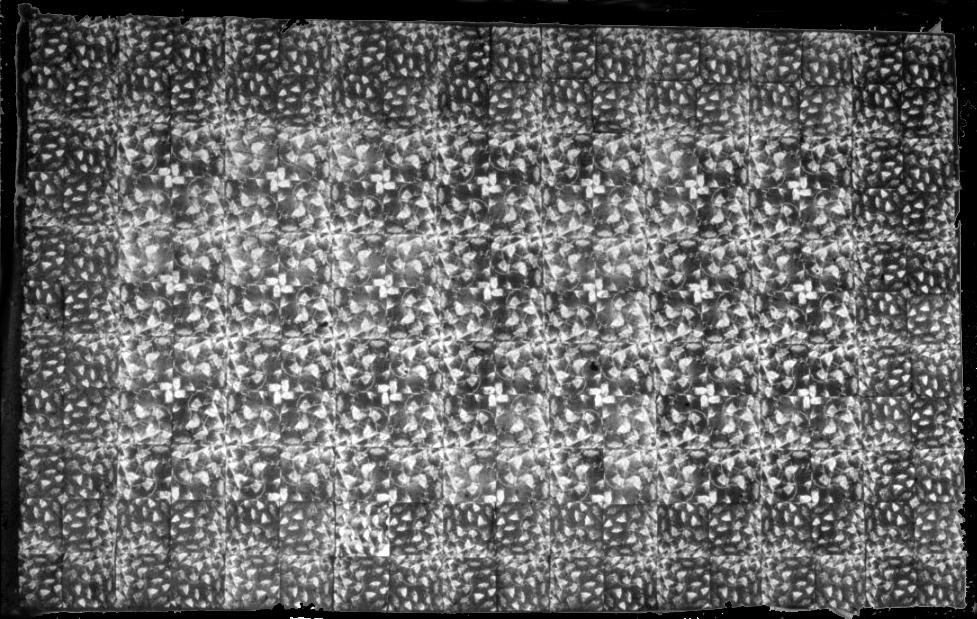
A long tessellated panel of photocopied date palm trunk patterns, double spirals repeated at two scales on black.

04 — 1978

Date Palm Rhythm

Photograph and photocopies of the photograph, tessellated on black-painted cardboard on a frame
Approx. 2 m (w)

Created during my first or second year at art school, this work emerged while I was studying photography and majoring in sculpture under Bert Flugelman. I was drawn away from photography’s slow and highly toxic wet processes toward the photocopier—a fast, fluid medium that allowed images to become a form of external thinking.

Influenced by M. C. Escher, Islamic art and recurring patterns in nature, I began with a single photograph of the double-spiral structure of a date palm trunk. I enlarged, cropped and repeated the photograph to construct a tessellation combining approximately life-size and enlarged forms.

The completed work extends for roughly two metres. The photocopies are mounted on black-painted cardboard attached to a frame. Slight undulations across the surface intensify its rhythm and sense of movement.

A version was exhibited at the Australian Centre for Photography, Sydney, in the 1980s.

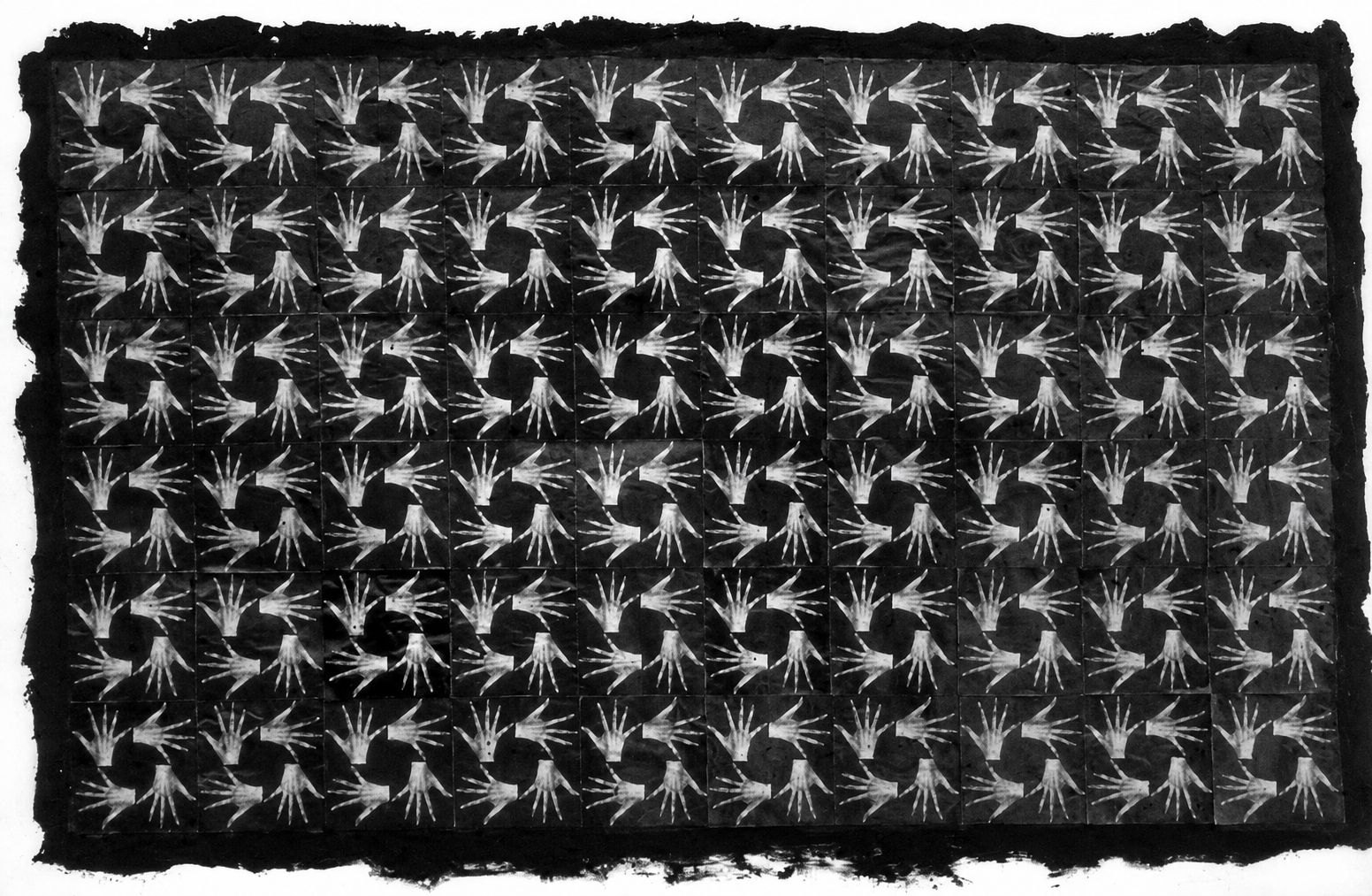
A grid of photocopied open hands rotating around dark centres, framed by a rough black border.

05 — Undated

Hand Rhythm

Photocopies on paper

Hand Rhythm uses repeated images of open hands to create a field of continuous rotation. For me, the hand is a symbol of desire—a form’s desire to reach, touch, grasp, possess and hold on to things. Yet these hands never arrive at an object. They circle one another and tumble through an apparently endless pattern, turning desire into a movement that can never be completed.

Within each repeated unit, the hands appear to rotate around a dark central absence. This void becomes both the object of desire and the space that can never be possessed. As the motif spreads across the surface, the individual hand loses its singular identity and becomes part of a larger rhythm—organic in its bodily imagery but almost mechanical in its repetition.

The grid gives the work an underlying order, while the changing tones, visible joins, creases and rough black perimeter resist perfect regularity. These physical imperfections keep the work restless and alive. The result is both decorative and psychologically unsettled: a pattern constructed from gestures of reaching, in which the desire to hold on becomes an endless cycle of attraction, movement and loss.

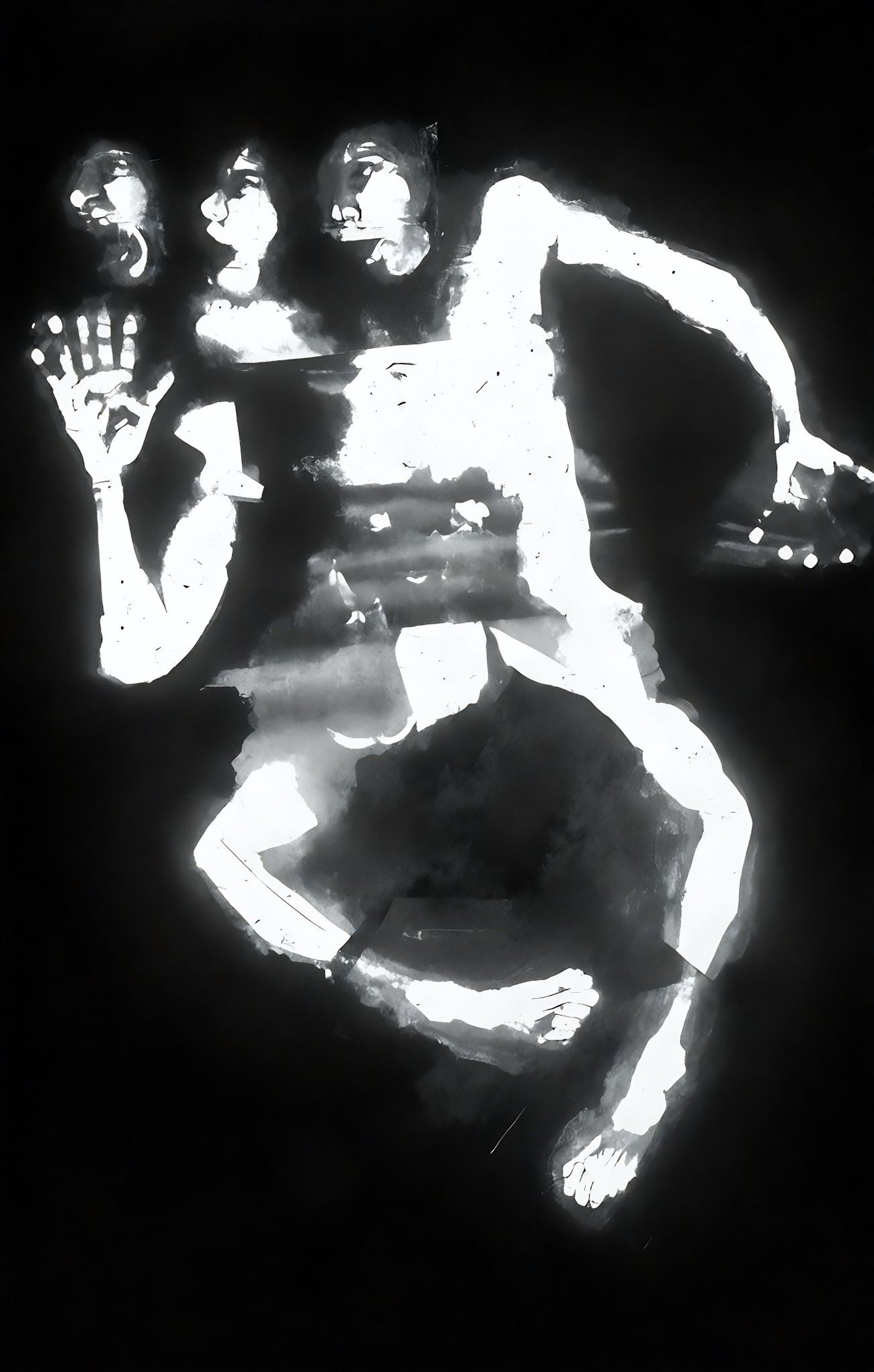
A life-size collage of a photocopied body, fragmented and suspended in black, with several screaming heads.

06 — 1983

Self Study

Photocopy collage and charcoal on black-painted paper, mounted behind perspex
Life-size; approx. 1.9 × 1.2 m

Self Study was constructed by photocopying sections of my entire body and reassembling them as an expressive, one-to-one-scale collage. The direct contact of the body with the photocopier compresses it against the picture plane, producing a stark physical trace rather than a conventional photographic portrait.

The figure appears suspended within a dense black void. Its anatomy is fragmented, displaced and diminished: arms and legs separate from the torso, hands reach outward, and repeated heads register successive states of a scream. These multiple faces suggest both movement and duration, as though terror is reverberating through time. The body seems simultaneously assembled and torn apart, struggling to remain coherent while being subjected to forces it cannot control.

Charcoal extends and disrupts the mechanical photocopies, creating areas of smoke, abrasion and shadow. The extreme contrast between exposed white flesh and surrounding darkness makes the void feel active rather than empty—it presses upon the figure, enters its fractures and threatens to consume it.

At approximately life-size, the work confronts the viewer as another bodily presence. It presents me pressed against the picture plane, isolated in darkness and screaming in a state of existential terror. The fragmented body becomes an image of the self being pulled apart by the forces of life: physically present, yet precarious, unstable and close to dissolution.

Shown in my first solo exhibition and in a group exhibition at the Australian Centre for Photography. The first of the Self Study series, which continues in my recent video work.

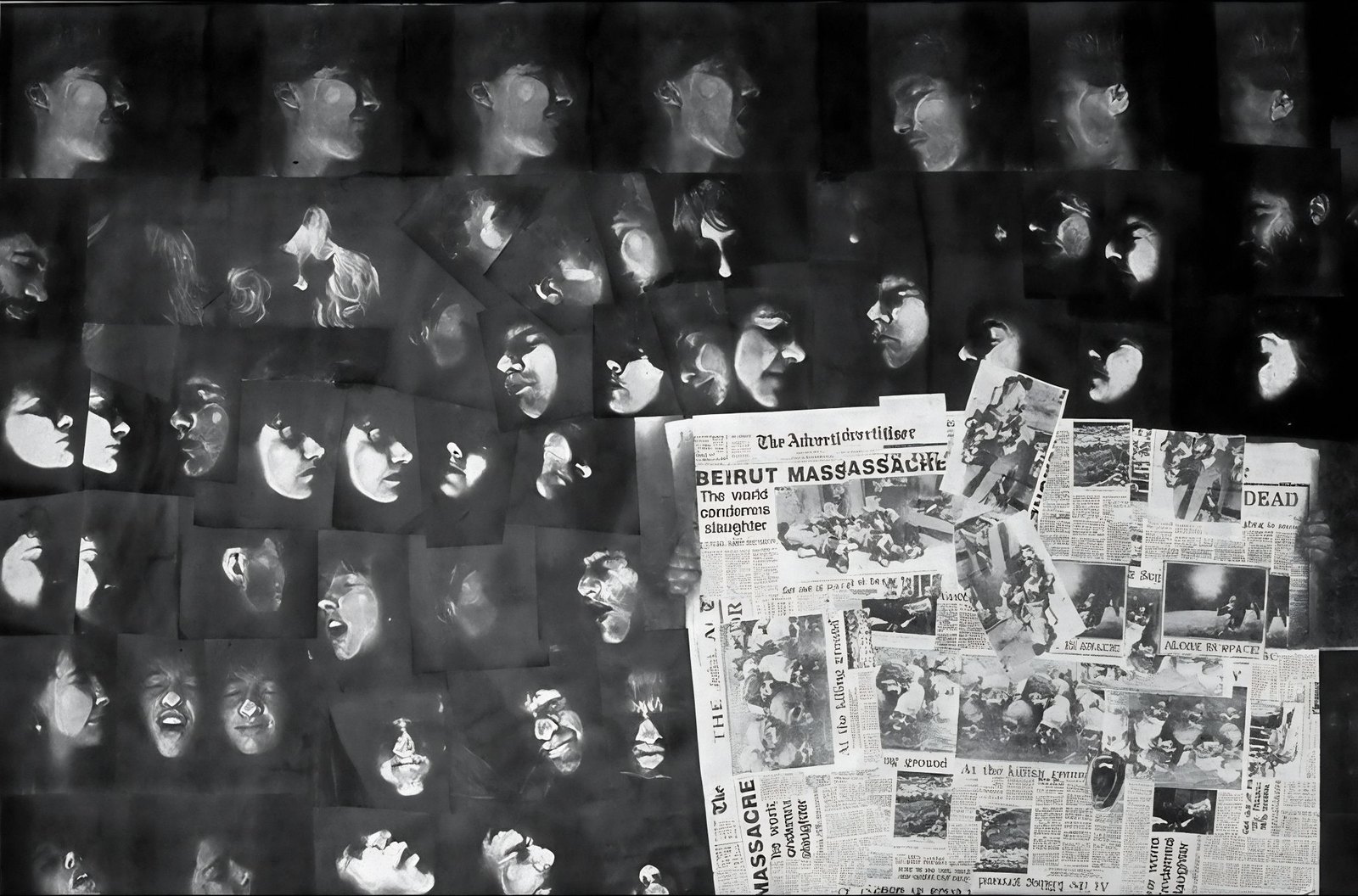
A large collage of photocopied faces with closed eyes emerging from darkness, with a man reading a newspaper in the lower right.

07 — 1984

Man Reading a Newspaper

Photocopies on paper on board, mounted behind perspex
2.3 × 1.5 m

Man Reading a Newspaper was produced as a commission for the Art and Technology Interface exhibition at the Adelaide Festival of Arts. Created during the same period as Self Study, it developed from my use of the photocopier as a direct means of recording the human body.

I invited people in a library to press their faces against the photocopier at approximately one-to-one scale. My instruction was that they close their eyes. Their faces were then assembled into a large collage: a crowd milling through darkness, physically close to one another but unable to see or acknowledge their surroundings. The overlapping sheets and variations in tone give the crowd a restless, unstable movement. Faces emerge briefly from the blackness before dissolving back into it.

In the lower-right corner, a man reads a newspaper. The paper is crowded with world events, including the killing fields of Pol Pot, a massacre in Lebanon and an astronaut floating in space. A smaller article concerns a child born without a face. Embedded within this accumulation is the only visible open eye in the work—an archival medical image I found in the Adelaide University Medical Library, depicting the eye of a man suffering from advanced syphilis and insanity.

This solitary eye appears to peer through the newspaper at both the surrounding crowd and the viewer. Yet its vision is disturbed and mediated by disease, technology and mass communication. The work sets collective blindness against an overwhelming field of information, asking whether exposure to images enables us to see the world more clearly or instead distances and desensitises us.

Commissioned for Art and Technology Interface, Adelaide Festival of Arts.

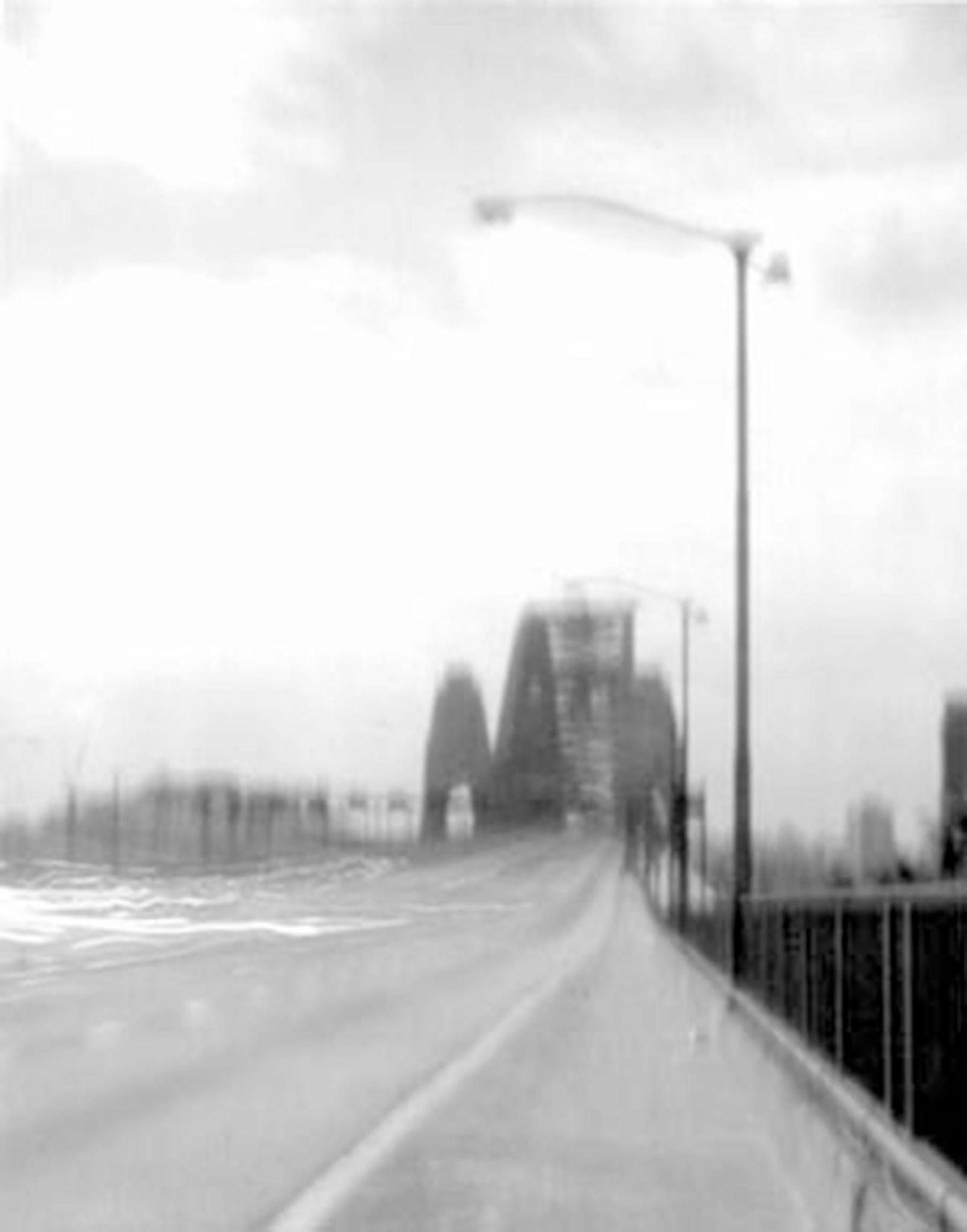
Harbour Bridge, a long-exposure pinhole photograph of the Sydney Harbour Bridge.

After 1984

Into the 1990s: the pinhole camera

Returning to art school in the early 1990s, I built a 4 × 5 pinhole camera with a Polaroid back during first-year photography with Anne Ferran. Pinhole was the set exercise; I turned it into an obsession — stretching exposures from seconds to minutes to break photography’s habit of slicing a single instant from time. Harbour Bridge was made with it on the eve of the millennium.

See the Pinhole Works →